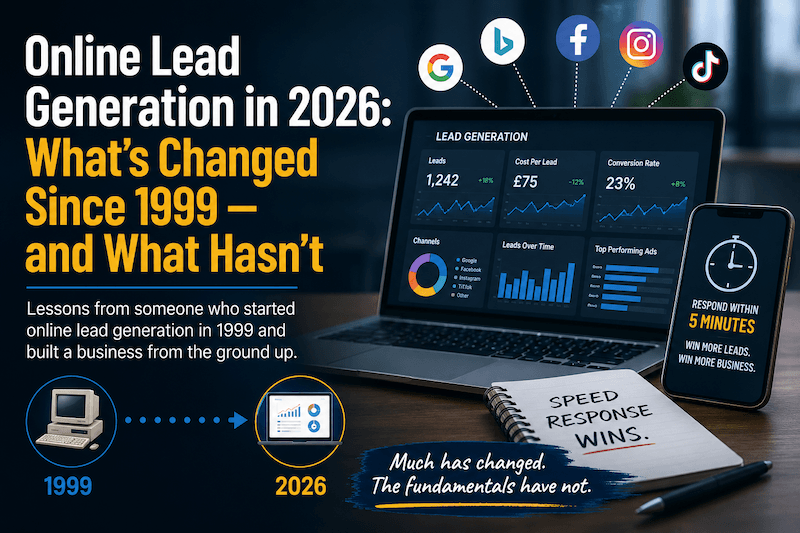
Reflections from someone who started generating online leads when almost nobody believed in it.
I often get asked a simple question:
“If you were launching an online lead generation business today, what would you do differently?”
It’s a fair question.
After all, I started in online lead generation back in 1999, at a time when the market barely existed. We launched our business in 2000, built it successfully, and eventually sold it in 2006.
This isn’t a “back in my day everything was better” article. It’s simply an observation from someone who experienced the early days of online lead generation and still works around the market today.
The reality is this:
Almost everything has changed – but one fundamental thing hasn’t.
The Early Days: When Nobody Believed in Buying Leads
Back in 1999, online lead generation felt like a strange idea to most businesses – at least here in the UK.
Businesses would say:
“Why would we buy leads online when we can advertise ourselves?”
To many, the concept sounded daft.
Nobody really believed consumers would fill in forms online asking to be contacted by companies – let alone that businesses would pay for those enquiries.
But times changed.
And quite quickly.
We built a successful lead generation business supplying enquiries across multiple sectors, including:
- Replacement windows
- Kitchens
- Conservatories
- Conservatory blinds
- Awnings
- Garage conversions
In truth, almost any home improvement product became a potential market for us.
And nearly all of our leads – probably 99% of them – came through SEO.
But SEO in those days bears little resemblance to what we see in 2026.
Margins were far higher. Competition was lighter. Tracking was simpler.
To put it bluntly, it was the Wild West of online marketing – but in a very positive way.
If you understood search engines even moderately well, moved quickly, and built useful websites, there were huge opportunities.
Why SEO Alone No Longer Works
This is probably the biggest change.
People often assume the answer today is:
“Just do SEO.”
But the reality is more complicated.
SEO still matters – but in my view, it’s no longer the engine that can build a highly profitable lead generation business on its own.
Could it contribute?
Yes.
Could it produce some leads?
Certainly.
But for most industries, especially competitive sectors, it is unlikely to be enough on its own to create a scalable and profitable lead generation model.
The economics have changed.
Competition has changed.
Consumer behaviour has changed.
And most importantly:
The people winning today are the people who understand data.
In 2026, the “Nerds” Are Winning
I say this with complete respect.
Today, the winners in online lead generation are often the statistical people.
The analysts.
The database people.
The performance marketers.
The agencies who obsess over measurement.
Because modern lead generation is ultimately a numbers game.
It comes down to this question:
Can you generate a lead cheaper than the average company can generate one themselves?
Let’s take a hypothetical example.
Imagine a company selling solar installations.
It would not be unusual for a company to spend around £150 to generate a single lead.
But that’s only part of the story.
Perhaps it takes three or four leads before they secure an in-home presentation or serious quotation opportunity.
By the time the maths is done, the cost of acquiring a customer could easily exceed £500 or even £1,000.
Now imagine an agency or lead generation company can offer leads at £30, £40 or £50 each.
Even if those leads are shared with several competing companies, the economics can still work.
Why?
Because if a lead generator can acquire that enquiry for, say, £75, and then sell it to multiple businesses for a combined £150–£175 gross revenue, there is still profit in the model.
That’s where modern lead generation businesses succeed.
Not through luck.
Not through simple SEO tricks.
But through measurement, optimisation, tracking and relentless testing.
Whether that traffic comes from:
- Bing
- TikTok
- SEO
…the principle is the same.
The best operators understand their numbers better than everyone else.
But Here’s What Hasn’t Changed Since 1999
Despite everything changing, there is one thing that remains exactly the same.
And in my opinion, it is still the single biggest factor separating success from failure.
Speed of response.
Nothing comes close.
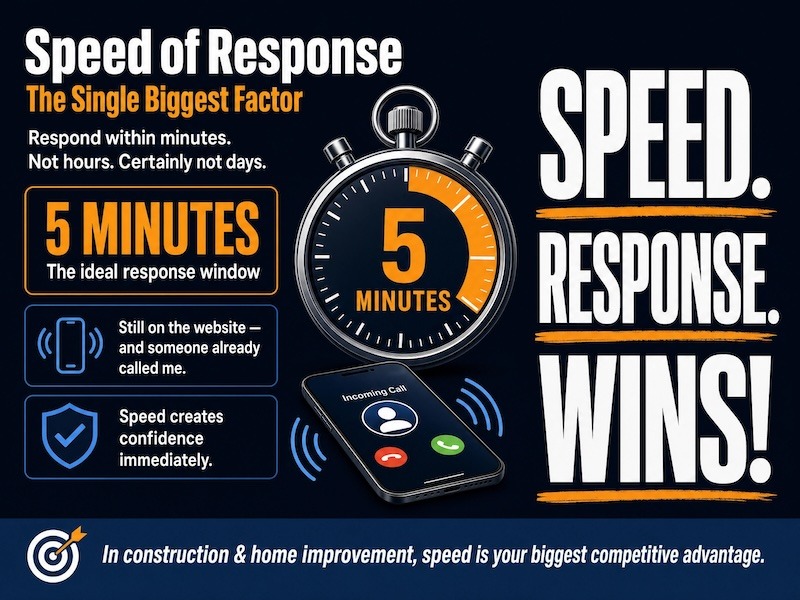
If you receive a lead, you should be responding within minutes.
Not hours.
Certainly not days.
Ideally?
Within five minutes.
I saw this repeatedly in my own business.
Clients would often tell me:
“I’m still on the website and somebody has already called me.”
Think about that from the customer’s perspective.
It feels professional.
It feels responsive.
And it creates confidence immediately.
Particularly in sectors like construction and home improvement – where many businesses are notoriously slow to respond – speed creates an enormous competitive advantage.
The Hidden Advantage of Fast Response
There’s another reason quick responses matter.
The faster somebody speaks to the customer, the less likely that customer is to continue searching.
If somebody reassures them quickly and says:
“Thanks for your enquiry – we’ll look after this for you,”
many consumers stop submitting further enquiries elsewhere.
That reduces competition.
And even in shared lead environments, speed frequently wins.
I saw countless examples of this.
Companies who responded quickly often secured the sale.
Companies who delayed usually blamed the leads.
I can remember customers trialling our service and complaining:
“These are the worst leads we’ve ever had.”
But when we looked deeper, the story was usually very different.
I’d ask:
“When did you call them?”
Sometimes the answer would be shocking.
A lead generated on Monday morning…
…and the business called Friday evening.
By then, the customer had already bought elsewhere.
Ironically, that often proved the opposite of what they believed:
The lead was actually excellent.
Somebody else had simply responded first.
The Fundamentals Still Matter
So yes – much has changed since 1999.
The market is more mature.
The margins are tighter.
SEO is harder.
Competition is fiercer.
And modern lead generation increasingly belongs to people who understand data, systems and performance marketing.
But the fundamentals remain surprisingly familiar.
And perhaps the biggest lesson of all is this:
The speed of response still matters more than almost anything else.
In fact, in 2026, it matters more than ever.
Because if you don’t respond quickly…
your competitors will.