AI Sales: a weekly series on BarryDunlop.com about where AI and home improvement selling meet, and what it means for your business. This is week two.

Last week’s post looked at customers pasting quotes into ChatGPT for a second opinion. This week the story has moved on a step: in America, AI is no longer just advising the homeowner. It is picking up the phone and calling suppliers for prices – and how your office answers that call can decide whether you make the shortlist at all.
Two other things crossed my desk this week: a practical guide to the “ChatGPT says it should cost half that” conversation, and a LinkedIn post shared with me about the half of selling AI cannot do. All three point the same way, so here is the week’s round-up and what I would do about it.
Google’s AI is phoning businesses for prices
Google has a feature, first tested under the name “Ask for Me”, that lets its AI make phone calls for you. A homeowner searching for something like “roofer near me” can opt to have Google’s AI phone a shortlist of local businesses, ask about pricing, availability, service area and the like, and then receive a written comparison – without making a single call themselves. The call arrives at your office like any other, except the caller announces itself as an automated system calling from Google on a customer’s behalf. According to Google’s own help page, these calls are also monitored and recorded.
Google first tested an earlier version with nail salons and auto shops in January 2025, then announced at its I/O event on 19 May 2026 that, for select categories like home repair, beauty and pet care, you can ask Google to call businesses on your behalf. Field Service Daily reported on 15 July that it is now live across the US for home repair searches, with subscribers to Google’s paid AI tiers getting access first. US marketing firms that serve remodelers are already advising them on exactly what their front desk should say when the AI calls.
The important bit for us: the homeowner’s comparison can only carry what your office actually told the AI. If the answer is “we don’t quote over the phone”, the risk is the customer sees your competitor’s price range and next available visit next to a blank from you. That is the argument being made by the trade marketing firms covering this, and they sell services around it, so allow for that – but the underlying mechanic is Google’s own, and it is hard to argue with. One practical detail from Google’s help page is worth knowing: saying “please stop calling my business” to one of these calls counts as opting out.
Two UK caveats. First, this is a US rollout, and even there Google lists five states where it is not available. Google says the feature is in “select regions and languages”, and I have found no confirmation of a UK launch date, so this is a watch-this-space, not a panic. Second, the direction of travel matters more than the date. If and when it arrives here, the businesses that cope best will be the ones that already know what their office says to a stranger asking for a price over the phone.
“ChatGPT says it should cost half that”
The second theme this week: the AI second opinion has moved from the evening after the appointment into the appointment itself. A guide published on 12 November by LocalPick (a firm that sells AI-visibility services to contractors, so note the angle) describes homeowners pulling out a phone mid-estimate and saying “ChatGPT says this should cost half that.” They found no formal data on how often it happens – and say so honestly – but contractors are talking about it. On the Jobber community forum, one asked others “How are you handling AI-generated advice from clients?”, and on the Mike Holt electrical forum, electricians have been debating whether ChatGPT is any use for estimating at all. The general view there: a useful cross-check, but never something to bid from blind.
Their suggested response is worth borrowing, and it is really just good selling:
- Ask to see it. “Can I take a look at what it said?” Reading the assumptions usually shows the gap – wrong size, different materials, no making good.
- Agree where it is right. If the range is reasonable, say so. It builds trust.
- Explain the difference in plain terms. “That figure assumes X. Your roof has Y, and here is what that adds.”
- Show the line items. A written, itemised estimate is easier to defend than a single number.
- Do not attack the tool. “ChatGPT is useless” sounds defensive. “It is a good starting point – here is what it cannot see” sounds like an expert.
They also make a point I agree with: put your pricing logic on your website. Not a fixed price list – a plain page explaining what drives the cost of your most common jobs, what a realistic range looks like, and what your quote includes. A 2026 homeowner survey by Roofing Contractor magazine found 65% of US homeowners were more likely to call a roofer whose website lists pricing, down from 78% the year before. The survey was sponsored by Owens Corning, the respondents skewed older (an average age of 58) and the sample size was not stated, so treat it as directional. A page like that helps the customer – and it is also exactly the kind of page an AI reads and quotes when someone asks it about you.
The half of the job AI cannot do
A LinkedIn post by Rosemary Harper was shared with me this week, and it has been doing the rounds. Her argument: AI can now do the efficient half of a sales job perfectly – fast answers, polished follow-ups, research – but it cannot show up in a room as a person who gives a damn. The work that actually wins hard deals is the unscalable part: the extra call with no agenda, the detail nobody wrote down but you remembered, the meeting you drove to that could have been an email. Effort only signals care, she says, when it costs the person something – and a machine pays no cost.
It is well argued, and it fits home improvement selling better than almost any other trade: you are in someone’s home, asking them to spend five figures. But two pinches of salt. First, the post ends with a pitch for an AI outreach agent, Leadhunt – it is a “the human touch is irreplaceable” post selling a robot. Second, she makes a harder point herself in a comment underneath: plenty of sales organisations say they value relationships and then measure reps on call quotas, pipeline velocity and activity scores. Whether organisations reward the unscalable work is a management choice, not a technology one. And the anxiety is real – back in July a rep at a mid-sized firm posted on Reddit that his CEO wants to replace the whole sales team with an AI agent. Most replies told him the CEO was wrong.
The research that ties it together: help customers make sense of it all
Here is the piece I found most useful this week, and it predates the AI wave entirely. In 2019, Gartner surveyed more than 1,000 B2B buyers and found something odd: 89% said the information they encountered during their purchase was high quality – and the sheer amount of good, often contradictory information was making decisions harder. Buyers drowning in trustworthy but conflicting information were 153% more likely to settle for a smaller, safer course of action than they had planned.
Gartner then looked at how sellers respond. Neither simply giving more information nor relying on personal experience and authority did the job. The approach that worked was what Gartner calls “sense-making”: helping the customer evaluate information, prioritise sources and reconcile the conflicts. Eighty per cent of sellers taking that approach closed what Gartner calls high-quality, low-regret deals.
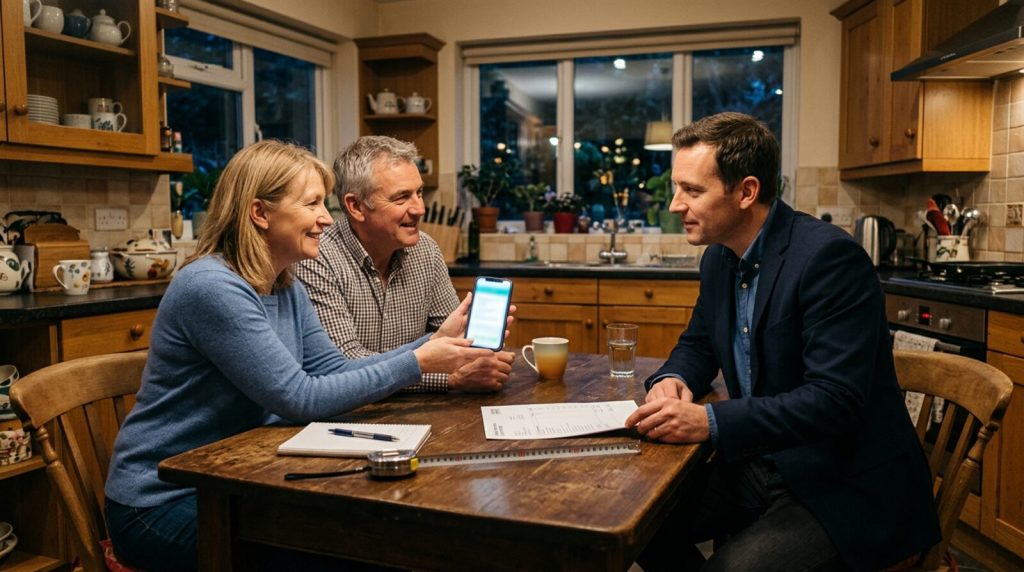
That was B2B research seven years ago, not home improvement – but tell me it does not describe a 2026 homeowner sitting at the kitchen table with three quotes, a ChatGPT printout, a Google AI price comparison and a neighbour’s opinion. The salesperson who helps that customer weigh it all – including agreeing with the AI where the AI is right – is doing the most valuable work in the sale. The robot can phone the office. It cannot sit at the table and help someone make sense of a confusing decision.
What I would do this week

My judgments again, not proven formulas:
- Agree your office’s answer to an AI price call before it happens. Even in the UK, where Google’s feature has not launched, “what do we say when someone asks for a price over the phone?” is a question worth having a real answer to: a range by job type, the next available survey slot, and one clear next step.
- Rehearse the ChatGPT-estimate conversation. Ask to see it, agree where it is right, explain what it cannot see, show your line items. The worst response is rubbishing the tool.
- Write the pricing-logic page on your website. What drives cost, honest ranges you can stand behind, what your quote includes. Good for customers, and it gives the AI something accurate to repeat about you.
- Protect the unscalable work. Turn up when you said you would. Remember the detail from the first visit. That was always the job; AI just makes it more visibly the job.
Next week I will keep an eye on whether Google’s AI calling gets any UK announcement, and keep digging Reddit and the trade press. If your office has already had a strange call from a robot asking for a price, I would genuinely like to hear about it.
Sources
- Google, “A new era for AI Search” (I/O 2026), 19 May 2026: https://blog.google/products-and-platforms/products/search/search-io-2026/
- Google Business Profile Help, “About automated calls and texts from Google to your business”: https://support.google.com/business/answer/7690269
- TechCrunch, “Google’s ‘Ask for Me’ feature calls businesses on your behalf to inquire about services, pricing”, Jan 2025: https://techcrunch.com/2025/01/30/googles-ask-for-me-feature-calls-businesses-on-your-behalf-to-inquire-about-services-pricing/
- The Verge, “Google’s ‘Ask for Me’ uses AI to call local businesses for you”, Jan 2025: https://www.theverge.com/news/603501/google-ask-for-me-search-labs
- Field Service Daily, “Google Will Now Call Your Shop and Ask for a Quote, No Human Involved”, 15 Jul 2026: https://fieldservicedaily.com/google-ai-calls-contractors-for-pricing
- Kitchen Remodeling SEO (trade marketing vendor), “What happens when Google’s AI calls a remodeling company for pricing”, 9 Nov 2026: https://kitchenremodelingseo.com/google-ai-calls-remodelers-for-prices/
- LocalPick (AI-visibility vendor), “A Customer Showed Me a ChatGPT Estimate: How Contractors Can Respond”, 12 Nov 2026: https://localpickai.com/guides/customer-showed-me-a-chatgpt-estimate
- Roofing Contractor (sponsored by Owens Corning), “The Homeowner’s Roofing Journey in 2026”, May 2026: https://www.roofingcontractor.com/homeowners-survey
- Mike Holt’s Forum, “Using ChatGPT for estimating”: https://forums.mikeholt.com/threads/using-chatgpt-for-estimating.2588830/page-2
- Rosemary Harper, LinkedIn post, “AI can do the efficient half of your sales job perfectly now…”, Nov 2026 (ends with a pitch for an AI outreach product): https://www.linkedin.com/posts/rosemary-harper-320829201_ai-can-do-the-efficient-half-of-your-sales-activity-7526109240395218944-LPTU
- Gartner press release, “Gartner Reveals New B2B Sales Approach to Win in Today’s Information Age” (survey of 1,000+ B2B customers), Jul 2019: https://www.gartner.com/en/newsroom/press-releases/2019-07-29-gartner-reveals-new-b2b-sales-approach-to-win-in-toda
- r/Sales_Professionals, “CEO wants to replace sales team with AI. am i crazy or is he?”, Jul 2026: https://www.reddit.com/r/Sales_Professionals/comments/1v1o891/ceo_wants_to_replace_sales_team_with_ai_am_i/
Vendor and survey figures are as reported by the sources above; forum and social posts are individual anecdotes. Google’s AI calling feature is US-only at the time of writing.